
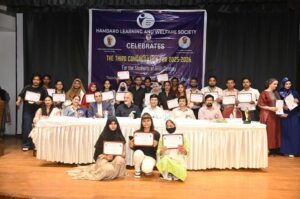


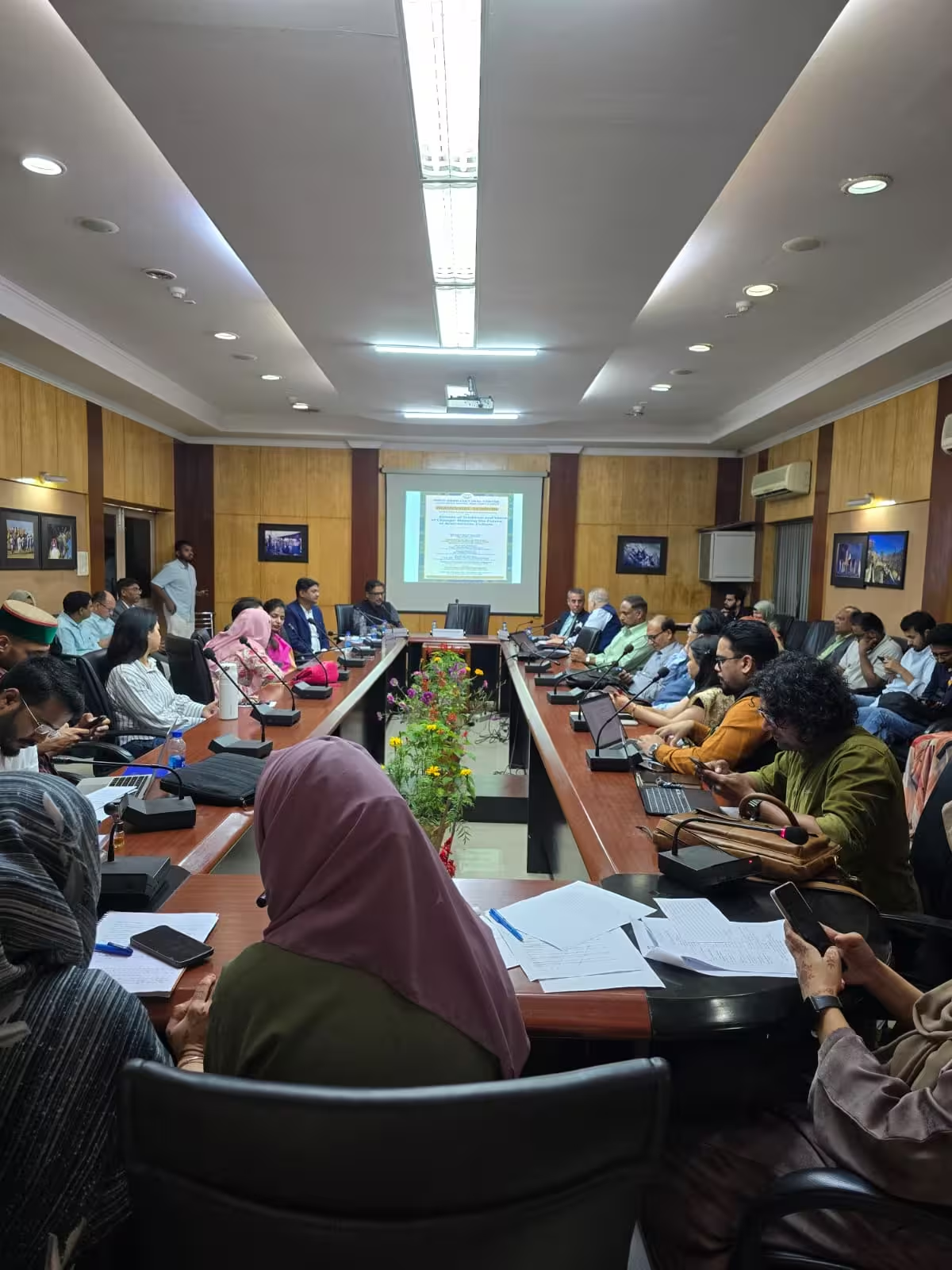
A day-long national conference on “Echoes of Tradition and Voices of Change: Mapping the Future of Arab-Islamic Culture” was organized by the India–Arab Cultural Centre (IACC) at Jamia Millia Islamia (JMI) on March 25, 2026 in which more than 25 scholars, academicians, and researchers deliberated upon the evolving dynamics of Arab-Islamic culture in the contemporary world.
The session began with the recitation of the verses from Holy Qur’an, followed by the welcome address delivered by Dr. Md. Aftab Ahmad, Director of the India–Arab Cultural Centre. He introduced the guests and theme of the conference to the audience and thanked Prof. Mazhar Asif, the Honorable Vice Chancellor and Prof Dr. Md Mahtab Alam Rizvi, Registrar for not only granting the permission to organize this conference but also supporting it financially. He also expressed his gratitude to all academicians, scholars, students and participants present there.
Prof. (Dr.) Mahtab Alam Rizvi expounded on the geopolitical relationship between India and the Arab world which he said represents a historically rooted and strategically evolving partnership shaped by geography, culture, economics, and shared global concerns from ancient trade networks across the Indian Ocean to contemporary diplomatic engagements – a relationship that has grown into a multidimensional cooperation framework.
Dr. Waiel Awwad stressed upon the significance of organizing such academic dialogues on Arab islamic culture in an era marked by global transformation and identified the key problems faced by Arab-Islamic culture.
The keynote speaker, Prof. Mujeebur Rahman highlighted that Arab-Islamic culture has historically been dynamic, inclusive, and knowledge-oriented, and stressed the importance of reinterpreting classical traditions to address contemporary challenges. He further emphasized the need to revisit Arab-Islamic cultural traditions in the light of globalization, modernity, and shifting socio-political realities.
Prof. H. A. Nazmi in his presidential remarks said that India and the Arab world share a dynamic and evolving partnership rooted in historical ties and shaped by contemporary strategic needs. It reflects a balance between tradition and modernity, cooperation and autonomy, and regional and global aspirations. Strengthening this relationship is crucial not only for mutual growth but also for ensuring stability and peace in a rapidly changing world order. A formal vote of thanks was proposed by Dr. Zulfikar Ali Ansari, the conference coordinator and Associate professor at India Arab Cultural Centre Jamia Millia Islamia.
The first technical session focused on the ‘History, Society and Culture’ in which eight scholars presented their papers on classical Islamic thought, Arabic literature, and the role of tradition in shaping cultural identity while the second technical session comprising seven academicians explored the themes like ‘Knowledge, Tradition and Cultural Exchange’. The scholars addressed the impact of modernity and reform movements on Arab-Islamic culture. Speakers also critically examined how colonial encounters, globalization, and technological advancements have influenced cultural expressions and identity formation. The third technical session was on ‘Politics and Society in the Arab World’ in which the speakers explored the future trajectory of Arab-Islamic culture in a globalized world. Scholars discussed emerging challenges and opportunities, including intercultural dialogue, digital humanities, and transnational cultural exchanges.
The valedictory session marked the conclusion of the conference. Prof. Rizwanur Rahman, the former Chairperson of Centre for Arabic and African Studies, JNU delivered the valedictory address. Prof. Rahman emphasised on the relevance of Arab-Islamic culture in fostering global understanding, the need for interdisciplinary research and strengthening academic collaborations between India and the Arab world. A number of research scholars and students including Prof. Abuzar Khairi (JMI), Prof. Nasir Raza Khan (IACC), Prof. Amarjeet (CNESPR), Prof. Anisur Rahman (CWAS), Prof. Sebastian N. (CWAS), Dr. Mohsin Ali (JMI), Prof. Mohammad Saleem (IGNOU), Dr. Mujeeb Akhtar (DU) and Dr. Qasim Adil (ZHDC, DU), Dr. Wasim Ahmad (SFL) and Dr. Suhaib Alam (JMI). The session was chaired by Prof. Nasim Akhtar, Head, Dept. of Arabic JMI. Dr. Ahsan Raza presented the conference report and proposed the vote of thanks.
Prof. Md. Mahtab Alam Rizvi, Registrar JMI graced the inaugural session as the Chief Guest. Prof. Mujeebur Rahman, former Chairperson of Centre for Arabic and African Studies, JNU delivered the keynote address while Dr. Waiel Awwad, Senior Arab journalist and Oday Hatim Mohammad, Charge d’ Affaires of Republic of Iraq to New Delhi graced the occasion as guest speaker and Guest of Honour respectively. The inaugural session was chaired by Prof. Hemanyun Akhtar Nazmi, Director, Centre for West Asian Studies, JMI.