


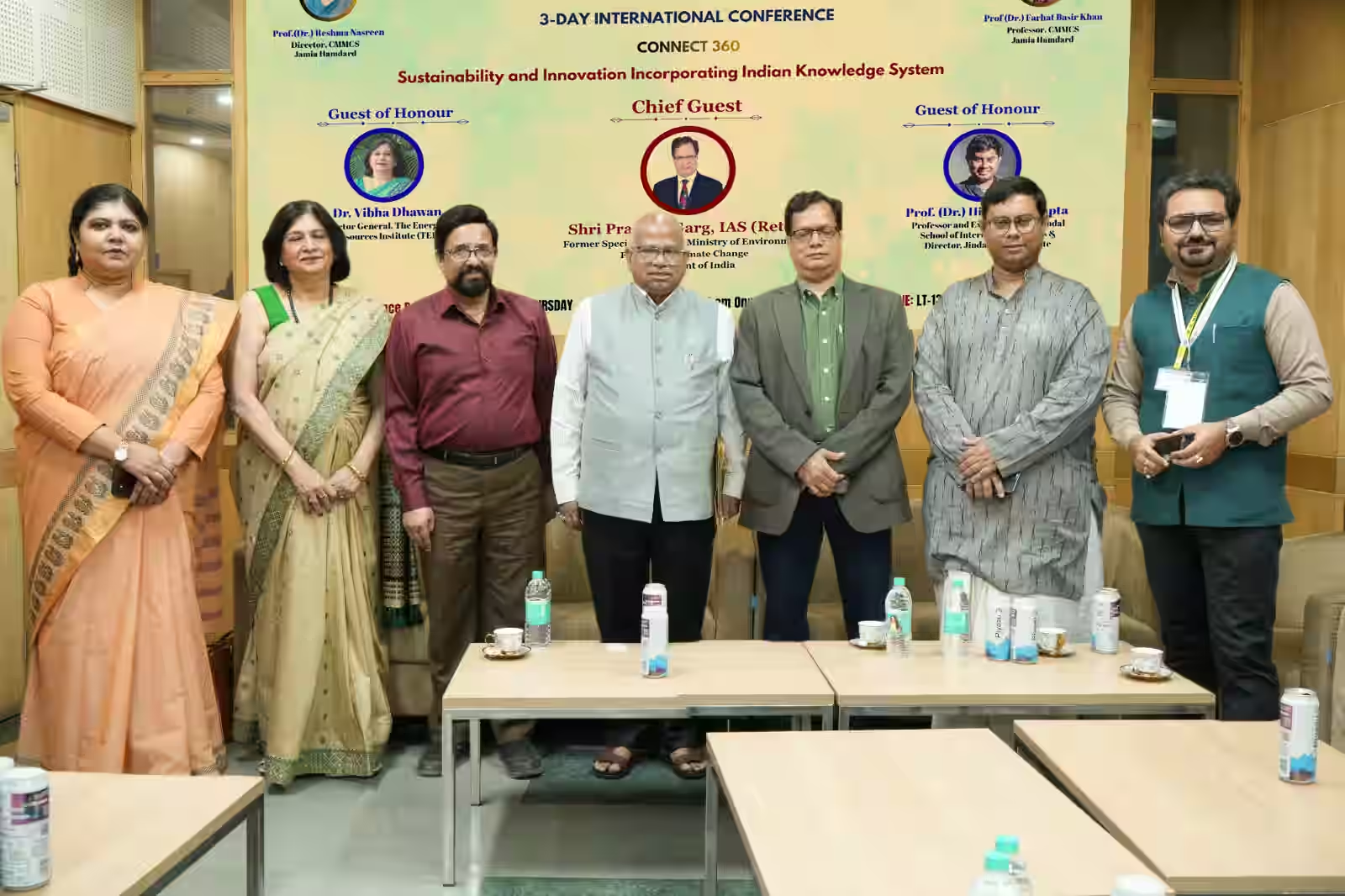
A high-level dialogue at Jamia Hamdard this week capital brought together an unusual mix of participants, including senior bureaucrats, scientists, policy thinkers, industry leaders, and grassroots practitioners. The discussion moved beyond the usual vocabulary of climate targets and sustainability metrics, turning instead to a deeper question: can long-term sustainability be achieved without rethinking the knowledge systems that shape how societies function?
The initiativeopened with a more fundamental question: have we misunderstood sustainability itself? It explored the role of Indian Knowledge Systems (IKS) in addressing the contemporary challenges of growth and environmental balance.At a high-level dialogue at the beginning of Day 2 of the CONNECT 360.


The initiative was conceptualised by Prof. Farhat Basir Khan, Organising Secretary of the day 2 of CONNECT 360 at Jamia Hamdard, who framed Indian Knowledge Systems as more than historical inheritance.


Institutional leadership framed the broader context of the discussions. Prof. (Dr.) M. Afshar Alam, a known proponent of the Indian Knowledge systems and the Vice Chancellor of Jamia Hamdard, observed that modern systems are increasingly returning to knowledge traditions that are thousands of years old, emphasizing the need to reconnect ecology with ethics. He added that modern systems must revisit traditional knowledge, particularly in linking ecological concerns with ethical frameworks.

The dialogue bore the imprint of Prof. Farhat Basir Khan’s ongoing work on Indian Knowledge Systems. Rather than approaching sustainability as a technical or sectoral issue, he framed it as a question of alignment between knowledge, practice, and values.

“Indian Knowledge Systems are not merely traditions of the past, they are frameworks of understanding that integrate knowledge, practice and values in a way that naturally leads to sustainability and balanced growth,” Khan said, setting the tone for the discussion.

The discussion that followed did not attempt to prove this idea. It unfolded through it.
The dialogue forms part of CONNECT 360, a tri-institutional collaboration involving Jamia Hamdard, K.R. Mangalam University and Bennett University, which includes academic sessions featuring research on sustainability and Indian Knowledge Systems.


Prof. Reshma Nasreen, Director, Centre for Media and Mass Communication Studies and the force behind the initiative, focused on the role of individuals and institutions, invoking the principle of Reduce, Reuse, Recycle as a basis for responsible action.

As the discussion moved forward, the dialogue brought together perspectives from governance, science, industry and community practice, gradually building a picture of sustainability as an outcome of how systems are designed.

From the policy side, Praveen Garg (IAS, Retd.), former Special Secretary, Ministry of Environment, Forest and Climate Change and the chief guest, first anchored the conversation in the present. Referring to a short film, “The Earth is speaking,” he framed sustainability as an immediate and lived challenge.

“Create, Consume, and Conserve must go together,” he said, setting a tone that was both simple and systemic.
From there, the discussion widened.
Scientific perspectives added another layer. Dr. Vibha Dhawan, Director General of The Energy and Resources Institute (TERI), approached the issue through the lens of science and policy. She outlined the interconnected nature of environmental, economic, and social systems, emphasising that sustainability cannot be addressed through isolated solutions. Her intervention pointed toward integration across technology, governance, and behaviour.

The discussion then turned to how traditional systems have historically embedded such balance.
Pankaj Mohindroo, Chairman of the India Cellular and Electronics Association (ICEA), and guest of honour, brought a critical dimension. He highlighted the scale at which India’s electronics manufacturing sector is expanding and the challenges that come with it, including resource efficiency, e-waste, and supply chain sustainability. He also empasaside using biowaste to power the Indian economy.
His intervention marked a shift in the discussion, making it clear that sustainability is no longer external to industry. It is central to how industries will operate and grow.
Prof Hindol Sengupta, Professor and Executive Dean at the Jindal School of International Affairs, and guest of honour, drew on historical examples to shift perspective. From India’s global trade in textiles to its early metallurgical practices, he suggested that the country’s past offers not just memory, but evidence of sophisticated systems.
His idea of Indo-futurism reframed the discussion, suggesting that the future of innovation may depend as much on intellectual confidence as on technological advancement.

Prof Qamar Irshad, guest of honour and the Dean Faculty of Architecture at Jamia Millia Islamia, and guest of honour at the keynote session highlighted how traditional architectural practices were designed in response to climate, rather than in opposition to it referring to climate-responsive architectural practices, while Prof. Afrina Rizvi, Chairperson, Department of Mass Communication and Journalism at Aligarh Muslim University, pointed to the role of communication in shaping how Indian Knowledge systems and sustainability is understood and acted upon, shaping public understanding and behaviour.
Bringing in a policy and global perspective, Ruchita Beri, Senior Fellow at the Vivekananda International Foundation, noted that several countries, including those in the BRICS region, have their own knowledge traditions that could support shared approaches to global challenges. Dr Nikhil Yadav, associated with Vivekananda Kendra, grounded the conversation in community-level practices, where sustainability is often embedded in everyday life.
Adding academic depth to the initiative, Prof. (Dr) Amit Chawla, Dean, K.R. Mangalam University, highlighted CONNECT 360 as more than a conventional academic gathering. He described it as a multi-institutional intellectual platform designed to bring diverse knowledge systems into dialogue. He noted that the scale and diversity of contributions reflected growing academic engagement at the intersection of sustainability and Indian Knowledge Systems, positioning CONNECT 360 as a convergence point for research, practice, and interdisciplinary inquiry.
As the discussions moved into the conference sessions, a common thread emerged: sustainability and growth may not be competing priorities, but outcomes shaped by how knowledge, systems and practices are aligned.