



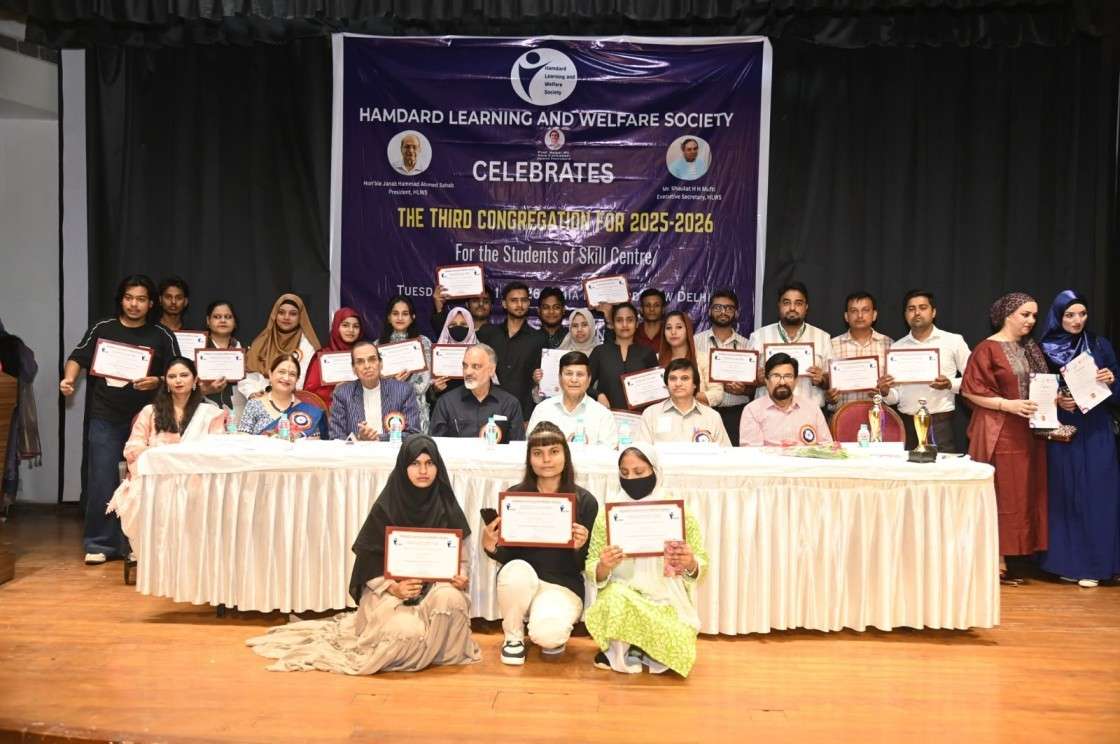
For the 184 students who graduated from the Hamdard Learning and Welfare Society (HLWS) this week, the annual Diploma and Certificate Distribution Ceremony was more than a formal conclusion to months of learning. For many, particularly young women from economically weaker and minority communities, it marked the beginning of a journey towards employment, confidence and financial independence.


A total of 184 students received diplomas and certificates in Basic Computing, Spoken English, Stitching, Urdu Stenography, Video Editing and Secretarial Practice. The programmes are designed to equip learners with practical skills that promote employability, entrepreneurship and self-reliance.

This year, however, the ceremony also reflected a changing vision of vocational education. Alongside conventional skill development, students are now being introduced to photography, videography and digital storytelling, fields that are increasingly creating opportunities in India’s expanding creative and digital economy.

The initiative is being led by Professor Dr. Farhat Basir Khan, Professor at the Centre for Media and Mass Communication Studies (CMMS), Jamia Hamdard, who has spent more than three decades working at the intersection of education, visual communication and social development.

His aim is simple: to ensure that young people, especially girls and first-generation learners, see creativity not merely as self-expression but as a pathway to livelihoods, entrepreneurship and dignity.
The initiative builds on Professor Khan’s long engagement with visual communication as an instrument of social change. Over the years, he has conceived and curated the Filmy Kaafila Film Festival, where children and young people from marginalised communities became filmmakers and storytellers rather than simply audiences.

He has curated photography exhibitions on mental health, organised an international travelling exhibition on violence against women in collaboration with organisations including Oxfam and the British Council, designed multimedia campaigns promoting democratic participation and voter awareness, and contributed communication initiatives for organisations such as UNICEF and the World Health Organization.
Across these diverse initiatives runs a common thread: using visual communication to create opportunity, encourage dialogue and address social challenges.
Addressing the gathering, Professor Khan highlighted one of HLWS’s most significant achievements, noting that nearly 90 per cent of the enrolled students are women.
“Women are not beneficiaries of development; they are its architects. Every educated and economically independent woman strengthens her family, her community and the nation. India’s aspiration of becoming a developed country can only be realised when women participate fully in education, innovation and the creative economy,” he said.
His remarks reflected the aspirations of many graduates, several of whom are the first in their families to pursue vocational education and are preparing to enter the workforce with new skills and renewed confidence.
The HLWS initiative also reflects a broader shift in the way creative skills are being viewed in India. Photography, videography and digital storytelling have become integral to sectors ranging from media and advertising to education, tourism, entrepreneurship and social development. By introducing these disciplines alongside traditional vocational courses, the programme is opening new possibilities for students who might otherwise have limited access to the creative industries.
The ceremony also acknowledged the contributions of Rukhsar, Firdous Khan and Zarran Quraishi, whose dedication has helped students prepare for employment, entrepreneurship and lifelong learning.
As the graduates stepped out with their certificates, many carried something more valuable than a qualification. They carried new skills, renewed confidence and the belief that their circumstances need not define their future.
For some, that future may begin with a computer, a sewing machine or a new workplace. For others, it may begin with a camera.
In the hands of a young woman discovering photography for the first time, a camera can become far more than a creative tool. It can become a profession, a business, a voice and the beginning of a future shaped by her own vision.
The ceremony was graced by Hammad Ahmed, Chancellor of Jamia Hamdard; Prof. Asgar Ali, Vice Chancellor, Jamia Hamdard; Shaukat Mufti, Executive Secretary, Hamdard Learning and Welfare Society (HLWS); Dr. S. Farooq, Managing Director, Himalaya Wellness Company; Professor Manju Chhugani, Professor, Jamia Hamdard; Professor Dr. Farhat Basir Khan, Professor, Centre for Media and Mass Communication Studies (CMMS), Jamia Hamdard; and distinguished guests from academia and civil society.
Note: Issued by HLWS.