
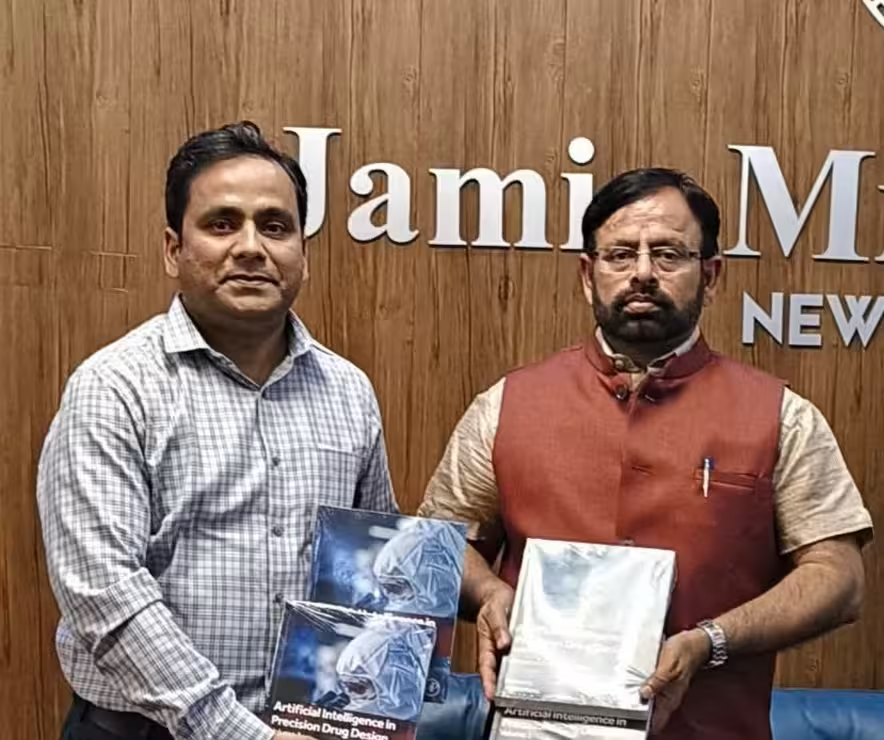
Dr Khalid Raza, Associate Professor in the Department of Computer Science at Jamia Millia Islamia, has published a two-volume edited book series titled ‘Artificial Intelligence in Precision Drug Design’, brought out by Academic Press, an imprint of Elsevier.
The volumes were formally released at the university in the presence of Vice-Chancellor Prof Mazhar Asif, and Registrar Prof Md Mahtab Alam Rizvi, who congratulated Dr Raza on this achievement and appreciated his contributions to interdisciplinary research at the interface of artificial intelligence and healthcare.
The two volumes together offer a clear and engaging view of how artificial intelligence is transforming drug discovery and precision medicine. The first volume, Foundations and Core Techniques, introduces key concepts and essential methodologies, while the second, Advanced Applications, focuses on emerging developments and real-world applications.
Across both volumes, the emphasis remains on how data-driven methods and intelligent algorithms are reshaping therapeutic research, with practical insights into predictive modeling and the integration of biological data with advanced computational approaches.
This publication marks an important step in strengthening research and innovation in precision drug design. By connecting foundational concepts with advanced applications, the volumes aim to support ongoing efforts to use artificial intelligence for improving healthcare outcomes and accelerating the development of new therapeutics.
Dr Raza has made notable contributions to AI-driven drug design and healthcare analytics. He is a recipient of the ‘Clarivate (Web of Science) India Excellence Research Citation Award 2025’ and has been consistently listed among the world’s top 2 per cent scientists. Dr Raza has also secured a research grant of Rs. 94 lakhs from ICMR for a project on ‘AI-driven drug design in breast cancer’.
Dr Raza expressed his gratitude to the Vice-Chancellor and the Registrar for their continuous support and motivation, highlighting that the institution’s research infrastructure and dynamic leadership have played a crucial role in enabling such academic achievements.
