
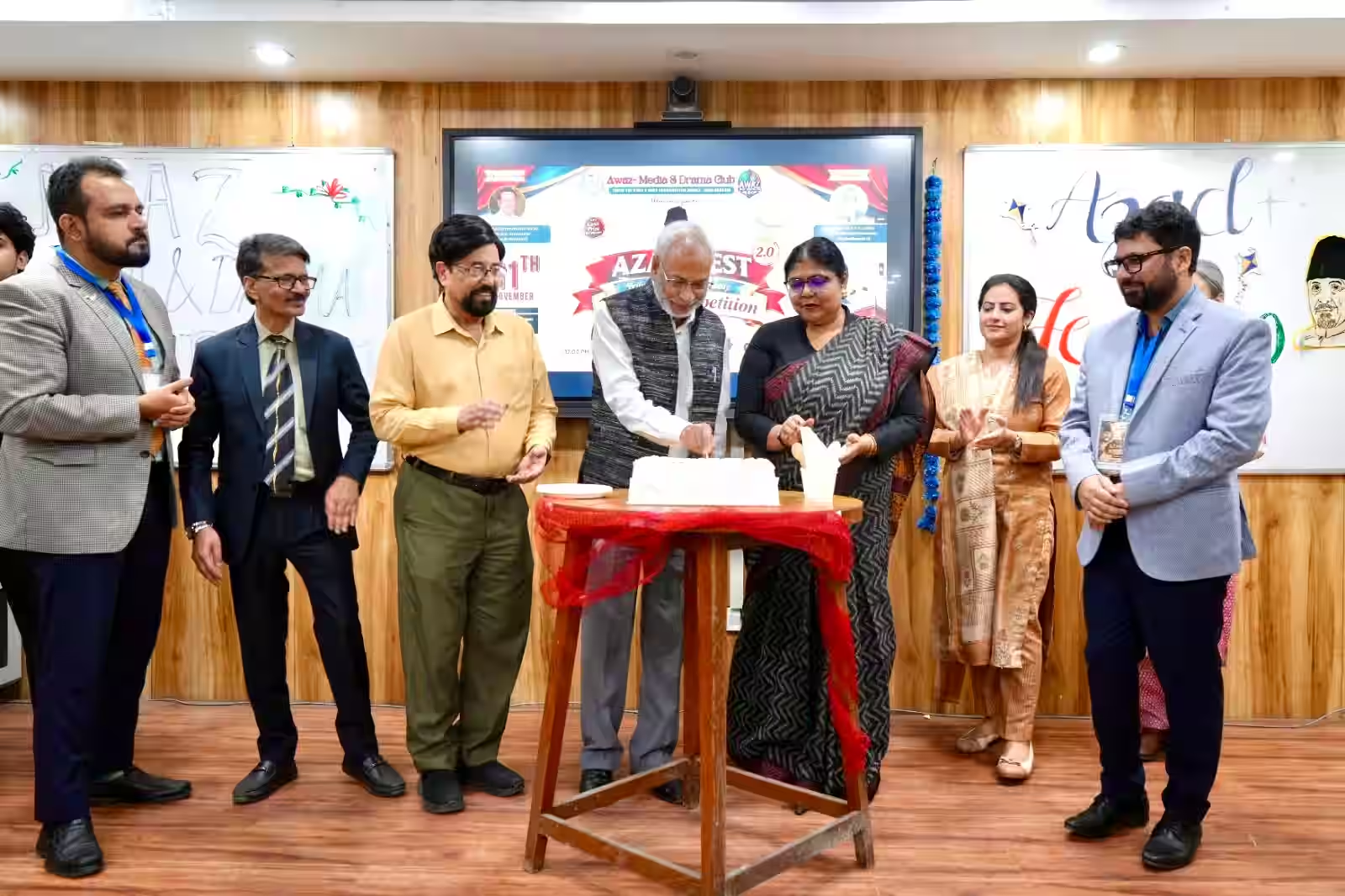
Jamia Hamdard marked National Education Day by organising Azad Fest 2.0 on Wednesday to honour Maulana Abul Kalam Azad’s legacy. The event, an inter-university trilingual speech competition, challenged students to examine whether education encourages independent thinking or merely trains them to follow a prescribed blueprint.

National Education Day is observed on November 11 to commemorate Azad’s birth anniversary. As independent India’s first Education Minister, Azad championed the expansion of education, scientific and technical learning, women’s education and the development of higher education and cultural institutions. His legacy remains closely tied to the idea that political freedom must be accompanied by intellectual empowerment.
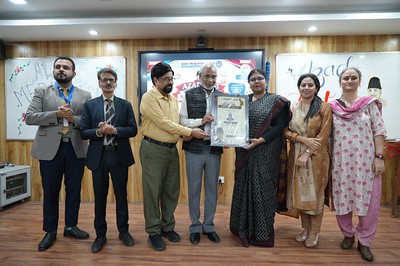
Professor (Dr.) M. Zainul Abidin, Vice-Chancellor of Jamia Hamdard; Professor Farhat Basir Khan, Guest of Honour; and Prof. (Dr.) Reshma Nasreen, convener of the programme, along with faculty members, judges, and students representing several universities, participated in the event. The Vice-Chancellor presided over the programme and presented awards.

In his address, Professor Khan reminded the audience of Azad’s remarkable journey as a journalist and educationist, as well as the challenges confronting today’s students. A distinguished media academic, author and communication strategist, Professor Khan has served as the Maulana Abul Kalam Azad Chair Professor at Jamia Millia Islamia. His association with the Chair lent particular significance to his reflections on Azad’s intellectual legacy.
Taking the audience back to 1912, he recalled how a 24-year-old Azad launched Al-Hilal, using journalism not simply to report events but to awaken political consciousness and encourage people to think beyond the boundaries imposed by colonial rule.
“The newspaper’s literary richness, intellectual ambition and advocacy of national unity made it a powerful voice of its time. Its suppression by the British, followed by the suppression of Azad’s subsequent publication, Al-Balagh, demonstrated the power independent journalism could wield over public thinking,” he said.

Professor Khan drew a compelling connection between that history and the present. In an age of algorithms, artificial intelligence and rapidly circulating misinformation, he emphasised that access to information must not be mistaken for understanding.
“For young journalists, the responsibility is to investigate, verify, question assumptions and recognise the human stories behind the facts. His central message was that education should produce people capable of asking difficult questions, not merely reproducing expected answers,” he said.
Professor Reshma Nasreen, convener of Azad Fest 2.0, highlighted the importance of student platforms such as Awaz in nurturing confidence, expression and participation. Director of the Centre for Media and Mass Communication (CMMS) at Jamia Hamdard, she appreciated the organising team’s efforts and encouraged students to pursue their ambitions, use opportunities, and develop their abilities beyond the classroom.
Awaz—Media & Drama Club of the Centre for Media and Mass Communication Studies, Jamia Hamdard —organised the programme at the SCLS Seminar Hall.
Its trilingual format brought students from several universities together, allowing them to articulate ideas and engage in debate across linguistic backgrounds. The theme, “Are We Truly Learning, or Just Following the Blueprint?”, invited participants to question whether formal education is fulfilling its larger purpose of developing curiosity, critical thinking and independent judgement.
The Vice-Chancellor, Professor (Dr.) M. Zainul Abidin, appreciated the faculty, organisers and student volunteers for their efforts and congratulated the participants. He also presented prizes to the winners, recognising their performance in a competition that emphasised argument, expression and confidence.
The judging panel comprised Dr Saad Ullah Khan, Assistant Professor at the Centre for Media and Mass Communication Studies; Prof. Khursheed Ahmad Ansari, Professor and Head of the Department of Tashreeh (Anatomy); and Dr Sahar Zaidi, Assistant Professor in the Department of Physiotherapy at Jamia Hamdard.
Adisha Khan of the University of Delhi secured first position, while Zanga Javed and Faiz Ahmed of Jamia Millia Islamia won second and third positions, respectively. The Vice-Chancellor and dignitaries presented the prizes, followed by the distribution of certificates to participants and volunteers.
The proceedings began with anchoring by Ziya and Anshika and a Qur’an recitation by Md. Saif.
Mudassir Rashid spoke about the beginnings of Awaz, while organising coordinator Shumaila Fatma was acknowledged for her contribution. The programme concluded with a vote of thanks and the National Anthem.
