
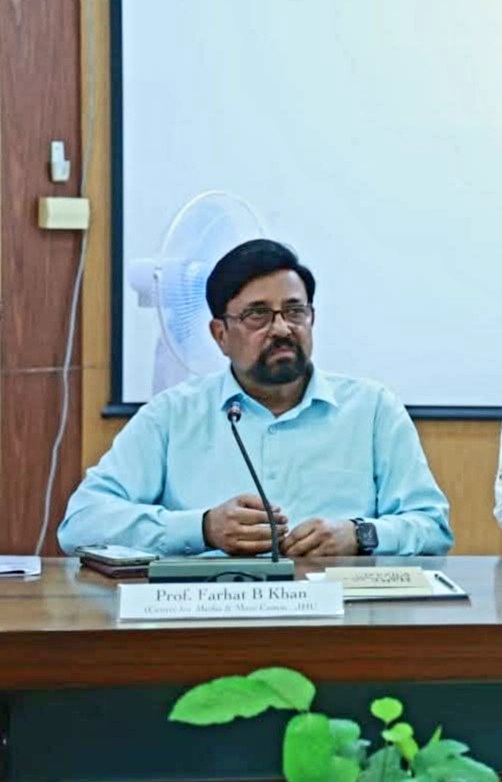
What made Maulana Abul Kalam Azad’s vision of India so distinctive? For Professor Farhat Basir Khan, the answer lies in the breadth of Azad’s mind: his ability to draw upon different intellectual traditions, his faith in education and his conviction that India’s diversity was central to its national identity.
Addressing the Azad Week Celebration 2026, organised by the MANUU Alumni Fraternity in Delhi, Professor Khan, former Maulana Azad Chair Professor at Jamia Millia Islamia, brought these ideas into conversation with India’s contemporary educational aspirations, particularly the National Education Policy 2020.
He began with Azad’s intellectual journey, recalling how the young scholar developed an interest in Sir Syed Ahmad Khan’s ideas on modern education and scientific thinking. He also recalled the remarkable story of the teenage Azad whose scholarship impressed the celebrated poet and scholar Altaf Hussain Hali, who described him as “an old head on young shoulders”.
For Professor Khan, these were not merely anecdotes about a gifted young man. They revealed an enduring commitment to curiosity, independent thinking and the pursuit of knowledge.
That commitment found a public expression in Al-Hilal, the journal Azad launched in Calcutta in 1912. Its pages brought together politics, history, literature, religious scholarship and wider intellectual reflection. It was an ambitious attempt to help readers see the connections between ideas and understand the larger forces shaping their times.
“He did not want merely to inform his readers; he wanted to enlarge their minds,” Professor Khan said.
He connected this expansive approach to the multidisciplinary vision of NEP 2020, with its emphasis on critical thinking, research, innovation and Indian Knowledge Systems. He suggested that Azad’s intellectual outlook offers a valuable reminder that knowledge grows when disciplines engage with one another.
“The challenge before us is not to choose between tradition and modernity, but to bring the strength of our knowledge traditions into productive dialogue with the demands of the future,” he observed.
The discussion then turned to Azad’s idea of India as a plural and shared civilisational space. Keynote speaker Qamar Agha, senior journalist and foreign-policy commentator, spoke about Azad’s concept of pluralism and composite nationalism. He recalled Azad’s opposition to Partition and his concern about the fragmentation of Muslims, observing that several of Azad’s arguments and concerns were not fully heard or appreciated in his own time. Agha’s reflections underlined the continuing relevance of Azad’s belief in a common national future.
Professor Khwaja M. Shahid, Guest of Honour and former Vice-Chancellor of Maulana Azad National Urdu University, highlighted Azad’s intellectual and literary legacy. Referring to Ghubar-e-Khatir and Azad’s translation of the Quran, he highlighted the remarkable range of Azad’s scholarship. Drawing on his own experience as Vice-Chancellor, Professor Shahid also reflected on the responsibility of an educational institution that carries Azad’s name and the importance of keeping his educational ideals alive.
Another important dimension of Professor Khan’s address was Azad’s contribution to institution-building. As India’s first Education Minister in an independent nation, Azad helped shape the foundations of modern education and higher learning. His vision also embraced literature, music, theatre and the visual arts. Supporting institutions devoted to these fields reflected his understanding that national development must nurture creativity and cultural confidence alongside science and technology.
The discussion was not confined to the speakers. Several question-and-answer sessions brought alumni and participants into conversation on Azad’s ideas, pluralism, education and the relevance of composite nationalism today.
A large gathering of Maulana Azad National Urdu University alumni gave the occasion the character of a reunion. The second part of the programme was devoted to cultural activities and introductions, bringing graduates from different batches and disciplines together and creating opportunities to renew old friendships and make new connections.
For Professor Farhat Basir Khan, Azad’s legacy is not simply a chapter in the history of modern India. It is an intellectual inheritance with a direct bearing on the country’s future: an India confident in its knowledge traditions, committed to educational excellence and strengthened by the contributions of its diverse communities.
His message brought the discussion back to a simple but powerful thought: “History gives us confidence; education gives us capability; culture gives us character”
